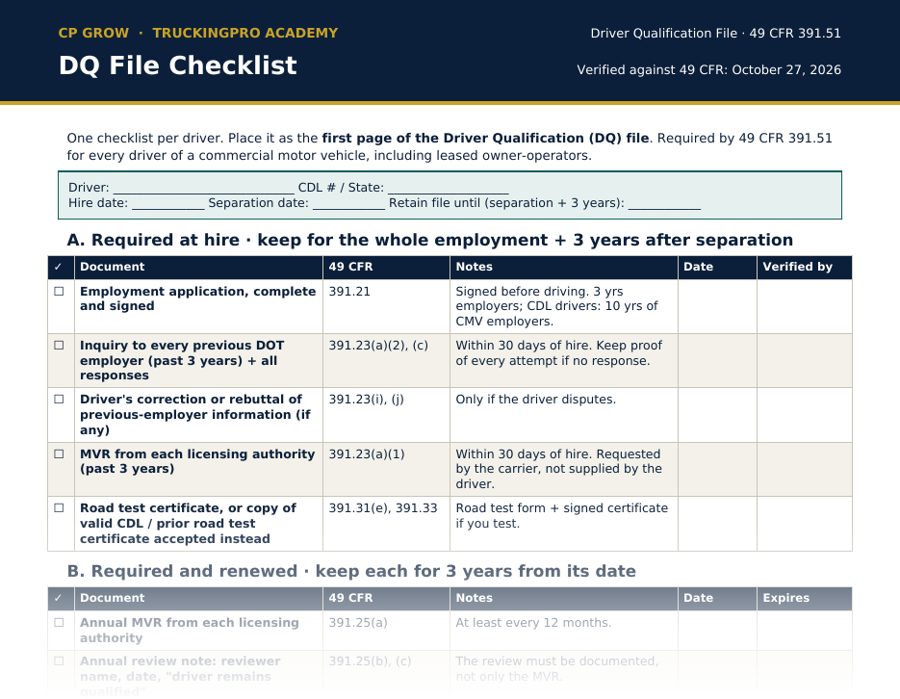
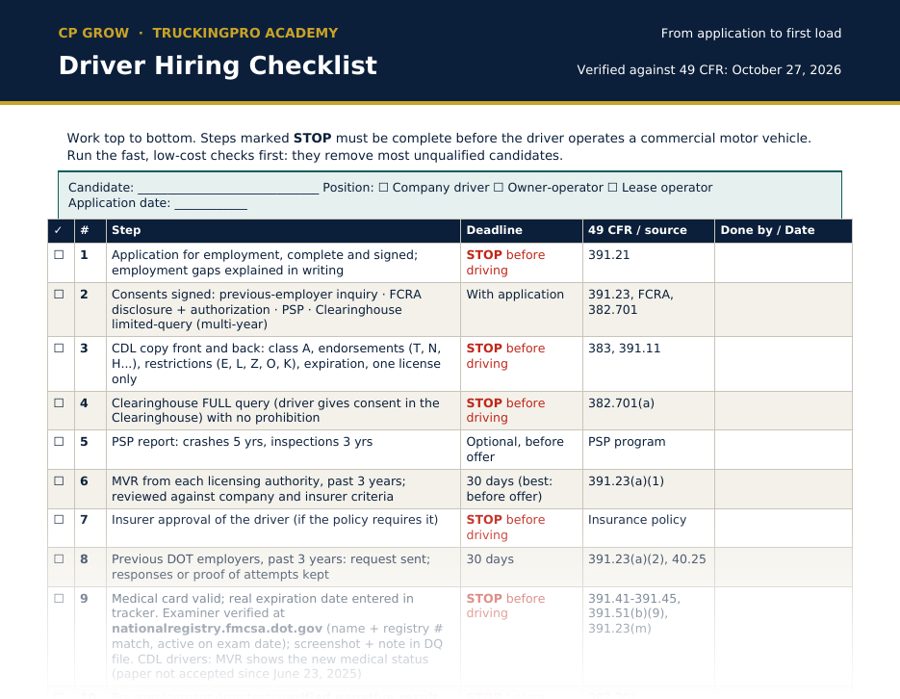
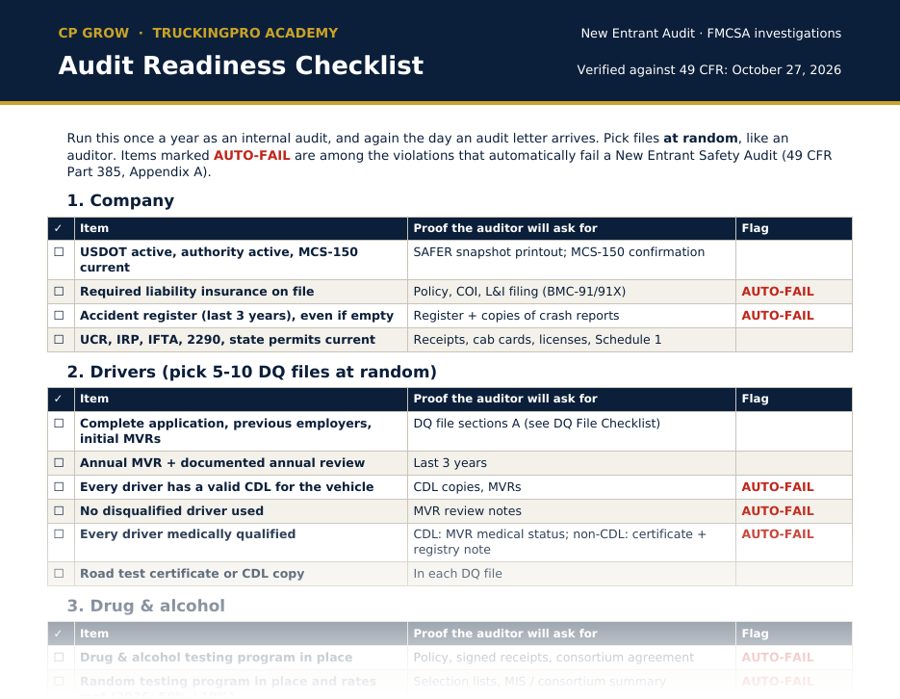
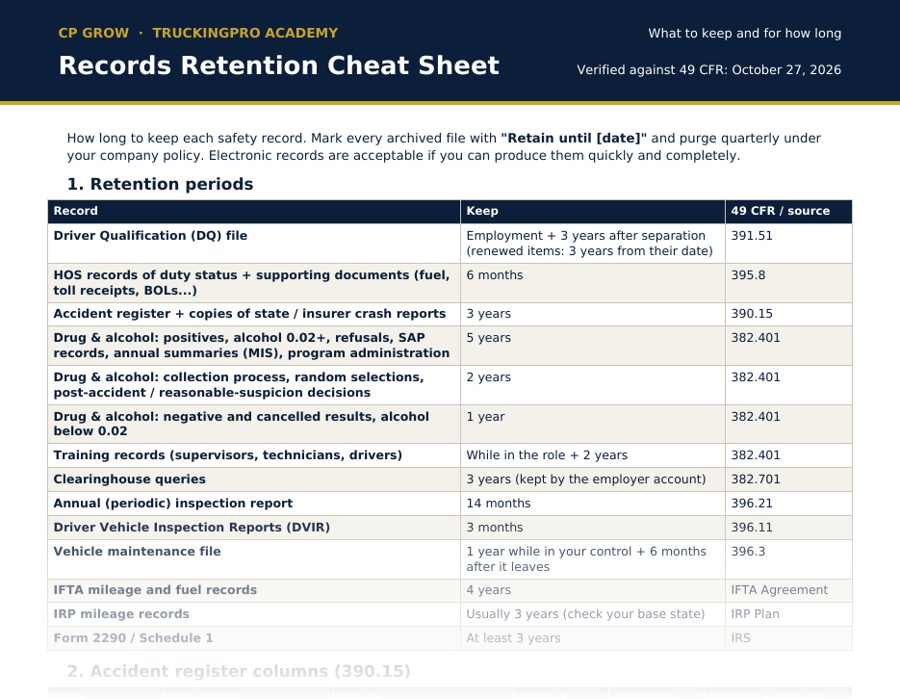
One page at the front of every Driver Qualification file. It lists every document 49 CFR 391.51 requires, the CFR section behind it, when it is due, and how long to keep it, so a file is complete before an auditor opens it.

Employment application (391.21), previous DOT employer inquiries within 30 days (391.23), MVR from each licensing authority, road test certificate or accepted CDL.
Annual MVR (391.25(a)), documented annual review, current medical certification, National Registry examiner verification (391.51(b)(9)), MVR medical status for CDL drivers.
ELDT completion (Part 380), LCV training, SPE certificate, medical exemptions, multiple-employer drivers, return-to-duty documentation.
Retain-until date (separation + 3 years) and a quarterly self-audit block.
The Driver Qualification file is the record a motor carrier must keep for every driver of a commercial motor vehicle under 49 CFR 391.51, including leased owner-operators. It proves the driver was qualified when hired and stays qualified.
For the whole employment plus 3 years after the driver leaves. Documents that are renewed, such as the annual MVR and the annual review, are kept 3 years from their date.
No. Since June 23, 2025, for CDL drivers the medical status shown on the MVR is the proof; a paper certificate is no longer accepted on its own. Non-CDL drivers still use the certificate.
No. Drug and alcohol records are kept in a separate, secured file under 49 CFR 382.401. The DQ file and the drug and alcohol file are different files.
Educational resource, not legal advice. Confirm every item in the current 49 CFR (ecfr.gov) and with FMCSA before acting.
The Safety & Compliance course explains US trucking safety step by step in 61 lessons: company compliance, hiring and DQ files, drug and alcohol, units, SMS scores, inspections, hours of service and FMCSA audits. English, Romanian and Russian, with an AI assistant in every lesson.
The full Safety Compliance Toolkit is included free.