Home › Resources › Drug & Alcohol Program Checklist
49 CFR Parts 382 and 40

Drug & Alcohol Program Checklist for FMCSA carriers

Set up or audit a DOT drug and alcohol program on two pages: program elements, the six test types and their key rules, what to do after a violation, how long to keep each record, and a month-by-month random testing tracker.

PDF · 2 pagesEnglishVerified October 27, 2026Instant download
$9This PDF only · instant download
Buy this checklist
$49Safety Compliance Toolkit: all 10 tools · $93 if bought separately
Get the Toolkit
Included freein the Safety & Compliance course (61 lessons)
See the course
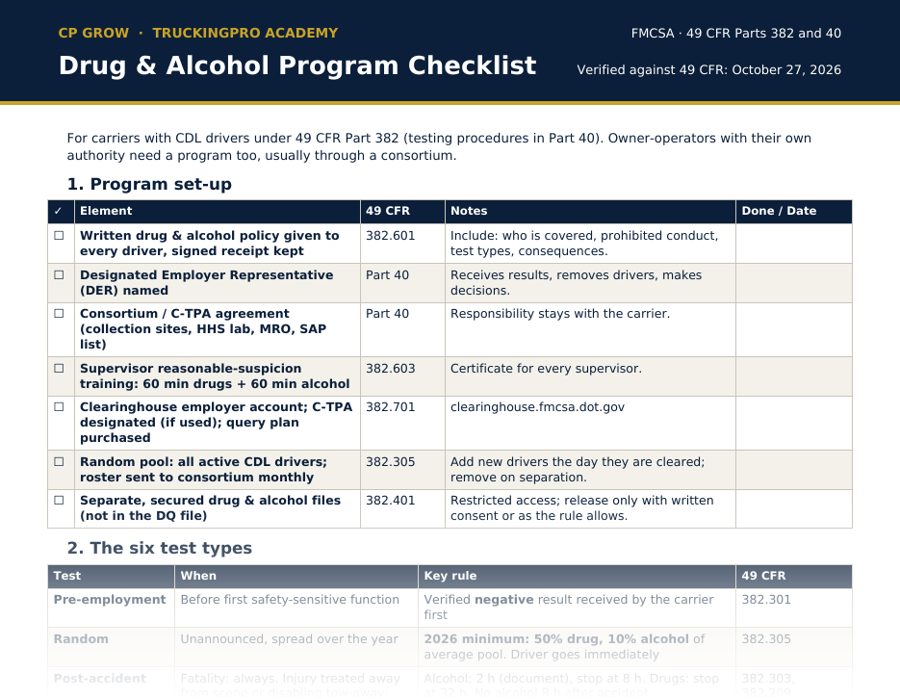
Drug & Alcohol Program Checklist: first page preview

What's inside

1. Program set-up

Written policy, DER, consortium/C-TPA, supervisor training, Clearinghouse account, random pool, separate secured files.

2. The six test types

Pre-employment, random, post-accident, reasonable suspicion, return-to-duty, follow-up, with timing and CFR section.

3. Violations

Immediate actions, SAP, Clearinghouse reporting deadline, 0.02-0.039 alcohol, marijuana.

4-5. Retention and random tracker

382.401 retention periods and a 12-month tracker for cumulative drug and alcohol percentages.

Sample items

  • 2026 random minimum: 50% drug, 10% alcohol of the average pool
  • Post-accident alcohol within 2 hours (stop at 8), drugs stop at 32 hours
  • Supervisor training: 60 minutes drugs + 60 minutes alcohol
  • Report refusals and other violations to the Clearinghouse by the end of the 3rd business day
  • Alcohol 0.02-0.039: off duty 24 hours
  • Drug and alcohol files kept separate from the DQ file

How to use it

  1. Use section 1 to check the program exists on paper.
  2. Give section 2 to whoever decides on post-accident tests.
  3. Fill the random tracker every month.
  4. If you are behind the 50% / 10% pace, tell the consortium now, not in December.

Who it's for

  • Designated Employer Representatives (DER)
  • Safety managers setting up a program
  • Owner-operators with their own authority (usually through a consortium)
  • Carriers preparing for an audit

Questions

What are the DOT random testing rates for 2026?

For FMCSA-regulated carriers, the minimum annual random rates for 2026 are 50% for drugs and 10% for alcohol, based on the average number of drivers in the pool.

When is a post-accident test required?

Always after a fatality. After an injury treated away from the scene or a disabling tow-away, only if the CMV driver receives a citation. Alcohol should be done within 2 hours (stop trying at 8), drugs within 32 hours.

Is marijuana allowed if it is legal in the driver's state?

No. Marijuana remains prohibited for DOT-covered drivers, including with a medical card.

Educational resource, not legal advice. Confirm every item in the current 49 CFR (ecfr.gov) and with FMCSA before acting.

Want to understand every item, not just tick it?

The Safety & Compliance course explains US trucking safety step by step in 61 lessons: company compliance, hiring and DQ files, drug and alcohol, units, SMS scores, inspections, hours of service and FMCSA audits. English, Romanian and Russian, with an AI assistant in every lesson.

The full Safety Compliance Toolkit is included free.

Related resources

All safety resources →